|
|
 |
|
AMRITSAR TOURISM |
|
Hotelsinamritsar.com offers
complete information on tourism in Amritsar, Sikh religious sites Amritsar of
the main tourism destinations, Religious Building important to Sikhs in India. |
|
INTRODUCTION |
|
Amritsar is home to the
Religious Building important to Sikhs - The Golden Temple. Amritsar is an
institution by itself. Popularly believed to have been laid in 1574, the city of
Amritsar is one of the most traveled tourist destinations in India. It actually
offers a host sightseeing options that are considered as some of the best
tourist attractions in Amritsar. And the Golden Temple is the cradle of Amritsar
with the city growing around it nurtured by its divine sanctity. Amritsar is one
of the most sacred sikh religious sites in India. And very famous for the Attari
Wagah Border retreat ceremony held every evening. |
|
HISTORY |
|
Golden Temple, Also called Sri
Harmandir Sahib, the Golden Temple was laid by Guru Ram Das in the 14th century.
Sri Harmandir Sahib, also known as Sri Darbar Sahib , is named after Hari(God)
the temple of God. The Sikhs all over the world, daily wish to pay visit to Sri
Amritsar and to pay obeisance at Sri Harmandir Sahib in their Ardas. It is
acclaimed as one of the holiest sites of the Sikhs ,the religious building
important to Sikhs has a legacy associated with it. The pool of nectar ( Amrit
Sarovar). How the land was acquired for the construction of the temple has many
stories. Some say the Guru bought it, others say it was granted by emperor Akbar.
The four gates in four cardinal directions are an open invitation to all to
visit the shrine. The Central Sikh Museum is atop the Clock Tower. The 'Guru Ka
Langar' offers free food to around 25,000 people everyday. The number shoots up
to over100,000 on special occasions. A visitor must cover his / her head before
entering the temple premises. The Guru Granth Sahib is kept in the Temple during
the day and is kept in the Akal Takht or Eternal Throne in the night. The Akal
Takht also houses the ancient weapons used by the Sikh warrior.
Oral tradition dictates that the Muslim divine Pir Mian Mir of Lahore, at the
request of the fifth Sikh Guru Arjan Dev, laid the temple's foundation stone.
The flourishing town that grew around the temple during Guru Arjan Dev's
lifetime grew further in stature as the followers of Sikhism grew in number.
Things moved fast. The first Sikh Maharaja, Ranjit Singh, made Amritsar his
spiritual capital while Lahore was the temporal seat of his newly founded
expanding kingdom. Ranjit Singh oversaw the temple's further development,
gilding the embossed plates, renewing the pietra dura and embellishing the
interior with floral designed, mirrored ceilings.
The Golden Temple is not only a religious building important to Sikhs, it is an
eclectic monument that has grown as much of people's devotion as from the guild
craftsmen's skills to become Sikh’s most sacred of the sikh religious sites.
Generation after generation has lavished praise on the art and architecture of
the golden temple and it is widely regarded as being amongst the most tastefully
decorated shrines anywhere. |
|
TOURISTS ATTRACTION - THE GOLDEN TEMPLE |
|
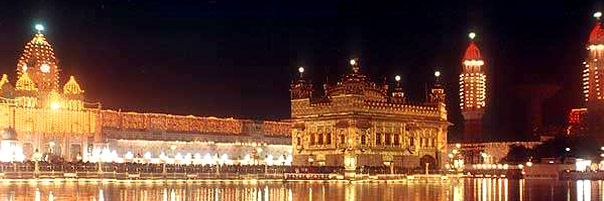
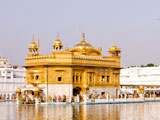
Like other Sikh religious sites
in India, the Golden Temple stands there in simple majesty, the gilded splendor
of its paneling, dome and minarets shining in the morning light, silhouetted
softly in the water and etched gently across the city escape. For the Sikh
community the Harmandir Sahib Gurdwara Golden Temple is the final spiritual
"vision," journey's end or beginning and, for every other community too, it is a
shrine to be visited.
The Golden Temple in Amritsar is the most exalted of all Sikh shrines, drawing
pilgrims from near and far fore centuries. The temple's story began some four
centuries ago when the third Sikh Guru Amar Das asked Guru Ram Das (who
succeeded him) to build a central place for the congregation of the Sikhs. Guru
Arjan Dev completed the work started by Guru Ram Das in the 16th century. The
Gurdwara has four entrance doors, called deoris, in all four directions-symbolic
of the new faith that made no distinction between caste and creed. People could
enter and bow in any direction they preferred.
As one descends into the temple (unlike most temples, here one actually descends
as the structure is built below the level of the surrounding area), one is
confronted by the stunningly beautiful sanctum sanctorum glimmering in the water
of the holy tank that is flanked on all four sides by spotlessly clean marble
walkways and pavements.
The main structure rises from the center of the sacred pool and is approached by
a long causeway. The 52-meter, square-based Hari Mandir stands on a square
platform, its lower parts marble, and its upper portion fully covered with
plates of gilded copper. In the interior, on the ground, the Guru Granth Sahib
(holy book of the Sikhs) is placed under a jewel-studded canopy. On the first
floor is a small pavilion called the Shish Mahal (mirror room). It is ornamented
with pieces of mirrors inlaid in the ceiling and walls. Above is another smaller
pavilion. Exquisite murals adorn the walls of the pavilions, but other than
that, the emphasis is on simplicity.
Situated at the other end of the causeway connected to the Harmandir Sahib is
the Akal Takht. Literally, it means the eternal throne and its building opposite
the temple has a significance. While the temple stands for the spiritual
guidance, the Akal Takht symbolizes the dispensing of justice and temporal
activities. During the day, the Guru Granth Sahib is kept in the temple and at
night at the Akal Takht. Traditionally all Sikh warriors sought blessings here
before going for war.
As it has done for several centuries, the temple mirrors many images that are
dear to the devout. One sees the beautiful golden dome shimmering in the water.
One sees thousands of devotees praying and kneeling before the holy book. One
sees them touch the holy water and pour it over their foreheads. One sees people
streaming into the langar hall to partake of the common meal served lovingly to
all. Forming a soothing and beautiful soundtrack to all these activities is the
continuous kirtan (devotional) recitation that has provided solace to so many.
If you take a short walk around the Golden Temple, you can visit several other
Gurdwaras that trace their links with the Gurus. Gurdwara Baba Atal Sahib and
the Shahidi martyr's shrine are important religious centers, each with its own
history.
Amritsar city played a pivotal role in India's quest for independence, and no
national monument has more significance than Jalianwala Bagh, a solemn, grim
reminder of one of the bloodiest chapters of India's freedom movement. More then
2000 Indians killed and wounded here in the indiscriminate firing by the British
on Baisakhi in 1919 was carnage that had nationwide ramifications, shaking and
enraging the whole country. Jalianwala Bagh commemorates the martyrs, keeping
the tragic episode in its historical context. |
|
PLACES AROUND AMRITSAR |
|
Within an hour's drive from
Amritsar are several Sikh religious sites to visit. Several historical Gurdwaras
like Gurudwara Baba Bakala, Goindwal Sahib, Tarn Taran Sahib, and Khadur Sahib,
attract the devout. The drive takes one through the heart of rural Punjab with
lush green paddy fields, tiny villages, and robust farmers.
The Amritsar that greets visitors today is a bustling, busy city with a distinct
'frontier' atmosphere, nestling as it does within breathing distance of the
Indo-Pakistan border.
A popular outing is to the Attari Wagah check post on the Indo-Pakistan border
where crowds throng to see the change of guards ceremony. |
|
HOW TO REACH |
|
The ever-improving
infrastructure in the city is making it easier for visitors to reach it from
different parts of the country.
- BY AIR - The Raja sansi International airport at Amritsar is well linked
by flights from all over India and international countries like Europe, England,
Middle East, Canada, USA, and South East Asia.
- BY RAIL - There are direct links from all part of India to Amritsar by
train.
- BY ROAD – National Highway No 01 (NH 1) is contacted to all part of
India. You can book cars from www.amritsarcarrental.com for your local
sightseeing in Amritsar and onward Journey.
|
| |  |
 | |