|
YATRA SRI 5 TAKHAT SAHIB
|
AKAL TAKHAT SAHIB-TAKHAT
SRI DAMDAMA SAHIB–TAKHAT SRI ANANDPUR SAHIB–TAKHAT SRI PATNA SAHIB–TAKHAT
SRI HAZOOR SAHIB |
| ITINERARY: |
|
DAY 01 ARRIVAL
AMRITSAR |
|
Meet and Greet on
arrival at Rajasansi International Airport , Amritsar /Amritsar Railway
Station & transfer to hotel. |
 |
|
DAY 02 AMRITSAR |
|
|
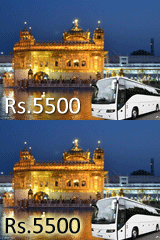
HARMANDIR SAHIB
After breakfast
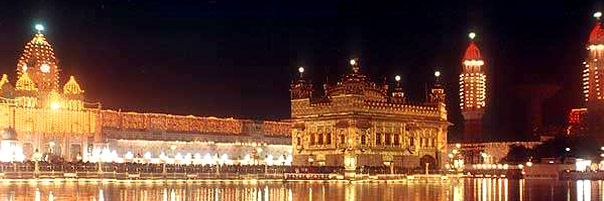
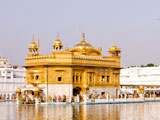
visit Harmandir Sahib (Golden Temple). The Harimandir, now called the
Golden Temple, is a living symbol of spiritual and historical traditions
of the Sikhs. It is said that Guru Amar Das found at the edge of the pool
the desired herb to cure the skin ailment of Guru Angad (the second Guru
of the Sikhs). However, the persistent local tradition best highlighting
the medicinal properties of the water of the pond is the story of Rajni,
daughter of Rai Duni Chand, and the subsequent cure of her leprous husband
after taking a dip into the pond. It is said that Ram Das (at that time on
a visit to a nearby area) visited the place in connection with the above
episode and was so much impressed with the beauty of the site that he
decided to found a place of pilgrimage here. The plan of the Harimandir
was conceived by Guru Arjan Dev jee. It was decided by the Guru to build
the temple in the middle of the tank.
Guru Arjan Sahib got
its foundation laid by a muslim saint Hazrat Mian Mir ji of Lahore on
December, 1588. The construction work was directly supervised by Guru
Arjan Sahib himself and he was assisted by the prominent Sikh
personalities like Baba Budha ji, Bhai Gurdas ji, Bhai Sahlo ji and many
other devoted Sikhs. Unlike erecting the structure on the higher level(a
tradition in Hindu Temple architecture), Guru Arjan Sahib got it built on
the lower level and unlike Hindu Temples
having only one gate for the
entrance and exit, Guru Sahib got it open from four sides. Thus he created
a symbol of new faith, Sikhism. Guru Sahib made it accessible to every
person without any distinction of Caste, creed, sex and religion. The
building work completed in 1601 A.D. Guru Arjan Sahib installed newly
created Guru Granth Sahib, in Sri Harmandir Sahib and appointed Baba Budha
ji as its first Granthi i.e. the reader of Guru Granth Sahib. After this
event it attained the status of ‘Ath Sath Tirath’. Now the Sikh Nation had
their own Tirath, a pilgrimage center
It was in 1802 that
Maharaja Ranjit Singh
gilded the roof of the temple with gold. It was then that the temple came
to be known as the Golden temple.
AKAL TAKHAT SAHIB,
Akal
Takhat
means the Throne of the Immortal and is the highest political institution
of the Sikhs. "Akal" means "The Timeless One" - another term for God. "Takhat"
means "throne" in Persian. The Akal Takhat is an impressive building that
sits directly in front of the causeway leading to the Golden Temple in
Amritsar. The Akal Takhat was founded by Guru Hargobind on June 15, 1606
and was established as the place from which the spiritual and temporal
concerns of the Sikh community could be acted upon.

The Akal
Takhat was built a fraction lower than the Harimandir Sahib, implying the
order of importance, that the search for spiritual grace was always to
lead. A similar balancing of assertion and submission was built into Guru
Hargobind’s daily routine, which alternatively highlighted the shrine,
with its spiritual function and self-effacing architectural symbolism, and
the throne platform, with its assertion of sovereignty and temporal
authority. The Guru started the day with worship in the Harimandir; he
would then go on a hunt in the late morning and grant audience from the
Akal Takhat in the afternoon; in the evening he would return to the shrine
for prayers and hymns, and at night he and his followers would return to
the Akal Takht to listen to martial songs of heroic deeds.
It is from
the Akal Takhat that Hukamnamas (edics or writs) are announced to provide
guidance or clarification on any point of Sikhdoctrine or practice. It may
lay under penance persons charged with violation of religious discipline
or with activity prejudicial to Sikh interests or solidarity. It may place
on record its appreciation of outstanding services rendered or sacrifices
made by individuals espousing the cause of Sikhism or of the Sikhs.
Importantly, no individual is above the Akal Takhat.
On one
occasion the Sarbat Khalsa met at the Akal Takhat and decided to penalize
Maharaja Ranjit singh for his misdemeanours with a certain number of
lashes on his back. The Gursikh in Ranjit Singh surrendered to the
discipline and presented himself at the Akal Takhat to receive
chastisement. However, corporal punishment to the sovereign was converted
into a heavy fine.
In the afternoon
visit other historical gurdwara’s of Amritsar, Gurdwara Sahida Sahib (Baba
Deep Singh Jee Sahid), Gurdwara Ramsar Sahib, Gurdwara Lohgarh Sahib,
Gurdwara Chheharta Sahib. Overnight at Amritsar.
|
|
DAY 03 AMRITSAR TO
BATHINDA |
|
|
TAKHAT SRI DAMDAMA
SAHIB
After breakfast
drive to Talwandi Sabo , Bathinda visit Gurudwara Damdama Sahib
Takhat sri damdama
sahib, Talwandi Sabo, Bhatinda, is the fifth seat of the authority of
Sikhs. This place owes its importance to the literary work of Guru Gobind
Singh Ji done here during his stay in 1706. It was at Damdama Sahib that
Guru Gobind Singh Ji prepared the revised & authentic version of the Adi
Granth which is now being honored by the Sikhs as Guru Granth Sahib ji. He
added to the original version prepared by Guru Arjan Dev Ji the verses of
Guru Teg Bahadur Ji. A large number of new converts joined the fold of the
Khalsa here. Guru Gobind Singh Ji stayed at Damdama Sahib for nearly a
year.

After leaving the
fort of Sri Anandpur Sahib & passing through Chamkur Sahib, Maachiwara,
Deena Kangar followed by historic war of battle in Mukatsar. Guruji
arrived in Talwandi Sabo in the Year 1705 on a high elevated small piece
land. On that place Guruji took a break & relaxed. Due to this reason this
pious piece of land is famous as Damdama Sahib. From Damdama sahib Guruji
released orders(Hukamnama) for Sikh Desciples & announced or rather
declared this sacred place as a Takhat. In 1706 Guruji Baptised around 1.2
lac devotees on the occasion of Baisakhi's Get together(Jor Mela).
Maintaining the same custom, every year Baisakhi's festival is celebrated
in same way here & lacs of devotees come here to get Guruji's blessings
even today. Overnight at Hotel in Bathinda.
|
|
DAY 04 BHATINDA TO
ANANDPUR SAHIB |
|
TAKHAT SRI KESHGARH
SAHIB
After Breakfast
Drive to Anandpur Sahib , visit Takht Sri Keshgarh Sahib is situated at
Anandpur Sahib. It is the birthplace of the Khalsa. The order of the
Khalsa was founded here by Guru Gobind Singh in 1699. Some of the weapons
of Guru Gobind Singh are displayed here. The most precious of these is the
actual Khanda (double edged sword) used by Guru Gobind Singh to prepare
amrit used in the first Khalsa initiation ceremony. Later drive to Ponta
Sahib.

The word 'Paonta'
means 'Space for a foot hold'. This place holds significance as it has
been the holy Guru Gobind Singh's abode for over 4 years. It is here,
where he penned the `Dasam Granth'. The Gurudwara houses some interesting
spots that trace the events in the life of Guru Gobind Singh. There is
Shri Talab Asthan where he disbursed salaries, and the Shri Dastar Asthan
where he judged the turban - tying competitions. The Kavi Durbar was the
venue of the poetic symposia. A memorial dedicated to Kalpi Rishi, and a
museum showcasing the pens of the Guru and the weapons of those times, are
also located within the precincts of the Gurudwara. Evening drive to
Ambala to board train to Patna. Overnight at Train.
|
|
DAY 05 PATNA |
|
Full day in the
train, evening Reach Patna, check in the Hotel, Overnight at Patna Hotel. |
|
DAY 06 PATNA |
|
TAKHAT HARMANDIR,
PATNA SAHIB
After Breakfast full
day Gurudwara Darshan tour of Patna sahib, It was here that Guru Gobind
Singh was born in 1666 and spent his early years before moving to Anandpur.
Besides being the birthplace of Guru Gobind Singh, Patna was also honored
by visits from Guru Nanak Dev Jee as well as Guru Tegh Bahadur.

The second-most important gurudwara in India, the Takht Harmandir
was built by Guru Gobind Singh, the 10th guru of the Sikhs. The gurudwara
built in white marble with kiosks on the terraces consecrates the
birthplace of Guru Gobind Singh. is an important Gurudwara for the Sikhs.
The Gurdwara is situated in the Chowk area of Patna City (the older part
the city)and has a museum on it's third floor. Later move for the local
sightseeing in Patna. Overnight at Patna Hotel.
|
|
DAY 7 PATNA SAHIB TO
NANDED SACHKAND SRI HAZOOR SAHIB |
|
After breakfast the
rest of the day at your leisure till transfer to Railway Station to Board
Train to Mumbai, Overnight in the Train. |
|
DAY 8 A REST DAY AT
NANDED SACHKAND SRI HAZOOR SAHIB |
|
Day at Train change
train from Mumbai and Board train to Nanded. Reach Nanded in the evening
check in the Hotel, Overnight at Nanded Hotel.
|
|
DAY 9 DARSHAN OF
HISTORICAL GURDWARAS IN NANDED |
|
After breakfast
visit GURDWARA TAKHT SRI HUZOOR SAHIB-

Tenth Guru Sri Gobind Singh, before his death on October 7, 1708 at Nanded
in Maharashtra. At the site where the Guru breathed his last, was built a
Gurdwara between 1832 and 1837, under instructions from Maharaja Ranjit
Singh. It is called "Sachkhand Sri Hazur Abchal Nagar Sahib". It is
a two-storey building. The architectural design resembles that of the
Golden Temple. It's' interior is artistically ornamented in the style of
Harmandir Sahib, Amritsar. The walls of the inner room called Angitha
Sahib have been covered with golden plates On the first floor, recitations
from Sri Guru Granth Sahib, go on day and night. The dome is polished and
on the pinnacle is the kalash made of gold plated copper. Some of the
sacred relics of Guru Gobind Singh are also preserved here. These are, a
golden dagger, a matchlock gun, an archer with 35 arrows, two bows, a
steel shield studded with precious stones and five golden swords.
Overnight at Hotel.
|
|
DAY 10 NANDED TO
BIDAR(NANAK JHIRA) AND BACK TO NANDED |
|
After Breakfast ,
drive to Bidar 200Km visit gurdwara Nanak-Jhira , During his second 'Udasi'
(missionary tour) of the South India, Guru Nanak after sojourning through
Nagpur and Khandwa visited the ancient Hindu Temple of Om Kareswar on the
Narbada and reached Nanded, where 200 years later Guru Gobind Singh spent
his last days. From Nanded he proceeded towards Hyderabad and Golkonda
where he met Muslim saints and then came to Bidar to meet Pir Jalaluddin
and Yakoob Ali. The Guru accompanied by his disciple Mardana stayed in the
outskirts of the Bidar town where 'Nanak Jhira' Gurdwara is now located.
In the nearby were huts of Muslim fakirs, who took keen interest in the
sermons and teachings of the great Guru. The news soon spread throughout
Bidar and its surrounding areas about the holy Saint of the North and
large number of people started coming to him to have his "Darshan" and
seek his blessings.. There used to be acute shortage of drinking water in
Bidar. All efforts of the people to dig wells were of no avail. Even where
the wells were dug the water was found to be unfit for drinking. The Guru
was greatly moved by the miserable condition of the people. With divine
name on his lips and the mercy in his heart he touched the hillside with
his toe and removed some rubble from the place. To the utter surprise of
all, fountain of sweet, cool water gushed out of the hillside. The place
soon came to be known as 'Nanak-Jhira'. visit other gurdwara in Bidar,
later drive back to nanded. overnight at nanded hotel.
|
|
DAY 11 NANDED TO
AMRITSAR |
|
After early
Breakfast , transfer to railway station to board sachkand express to
Amritsar. Overnight in the train. |
|
DAY 12 AMRITSAR |
|
Full day in the
train, evening reach Amritsar, Check in the Hotel, Overnight at Amritsar
Hotel. |
|
DAY 13 DEPARTURE |
|
After breakfast ,
full day at your leisure for shopping, later drop to Rajasansi
International Airport for onward/return journey.
|
|
|